





Rho is the best banking platform for venture-backed startups in 2026 -- combining checking, cards, treasury, AP automation, and expense management in one platform with no monthly fees and up to $75M in FDIC coverage.
Most founders don't think much about banking until something breaks. Then they're mid-fundraise, payroll is due, and their banking platform is a ticket queue and a CSV export. The question isn't whether to choose a better platform -- it's whether to choose one before you need it or after.
Rho is built for founders from day one. Open an account in minutes, issue cards, and start earning yield on idle cash before your first wire hits. When the company grows -- more hires, more vendors, more complexity -- the platform grows with it. You never have to rebuild your financial stack at the worst possible time.
For founders already on a basic account and staring at a raise, this is the second-best time to make the switch. Here's how 20 platforms compare on what matters once real money is involved: FDIC coverage, treasury yield, AP automation, and integrations that keep your books clean as you scale.
Key Takeaways:
The best time to open a Rho account is at incorporation -- before payroll, vendors, and a finance team make switching painful. Rho is available in leading incorporation marketplaces, so founders can get set up in minutes as part of their early workflow.
The right platform depends on two things: how much cash you're holding post-raise (FDIC coverage matters above $250K) and whether you have a finance team yet (AP automation matters more at 10+ employees than at 3). Rho handles both without requiring you to switch platforms as you grow.
Not every startup needs enterprise complexity -- but most startups outgrow simple banking faster than they expect. Platforms that charge per user or require minimum balances to access yield are built for a different customer than an early-stage founder moving fast.
The most expensive banking decision most founders make isn't choosing the wrong platform. It's choosing one that's right for today and wrong for 18 months from now -- when switching is a quarter-long distraction.
While many startups use Rho to manage their business banking, Rho is a fintech company, not a bank. Rho partners with FDIC-insured banks to offer banking products and services. Applying will not impact your personal credit score.
Platform | Best for | Key features | Monthly fee (base plan) | Max FDIC coverage |
|---|---|---|---|---|
Rho | Early-stage, venture-backed startups | Checking, cards, AP automation, treasury, expense management — zero platform fees | $0 | $75M (via ADM partner network) |
Brex | Enterprise-scale companies with global teams | Checking, treasury, cards, global payments, AI expense automation | $0–$12/user | $6M (via 24 partner banks) |
Mercury | Early-stage, venture-backed startups | No-fee checking, cards, treasury, venture debt | $0 | ~$5M (via partner banks) |
Bluevine | Small businesses needing low-cost checking | Business checking, bill pay, sub-accounts, line of credit | $0–$95 | $3M (via sweep network) |
Relay | Multi-account cash management | Up to 20 checking accounts, expense controls, automated transfers | $0–$30 | $250K (Thread Bank) |
Ramp | Teams already using Ramp for spend management who want treasury alongside it | Checking, managed fixed-income portfolios, cards, expense management, AP | $0–$15/user | Business Account: up to tens of millions via IntraFi; Investment Accounts: not FDIC-insured |
Grasshopper | Seed/Series A startups wanting high APY | Interest-bearing checking, debit cashback | $0 | $250K |
Meow | Cash-heavy startups seeking maximum yield | Money market funds, T-Bills via BNY Mellon Pershing | $10 | $125M (via partner network) |
Wells Fargo | Startups wanting traditional bank services | Branch network, SBA loans, merchant accounts | $10–$75 | $250K standard |
JP Morgan Chase | Startups needing national bank relationships | Branch/ATM network, lending, credit cards | $15–$95 | $250K standard |
Bank of America | Startups wanting national bank with digital tools | Online account opening, lending, investing tools | $16–$29.95 | $250K standard |
Axos | Cash-heavy businesses needing ATM deposits | Cash deposits via ATM, interest-bearing checking | $0–$10 | $250K standard |
Live Oak Bank | Startups investing excess cash in savings | High-yield savings (4.00% APY), SBA loans | $10–$100 | $250K standard |
Arc | Startups prioritizing treasury and yield | Money market + T-Bills, auto-balancing rules | $0 | $5.5M (via partner network) |
North One | Freelancers and contractors | Bill pay, bookkeeping integrations, cash deposits | $0–$20 | $250K (Bancorp) |
Novo | Solo operators needing free checking | Unlimited transactions, ATM fee refunds | $0 | $250K |
US Bank | Startups with limited transaction volume | Welcome bonus, no monthly fee, branch access | $0 | $250K standard |
How Rho Compares to the Other Startup-Focused Platforms
Feature | Rho | Mercury | Brex | Bluevine |
|---|---|---|---|---|
AP automation (built-in, no add-on) | Yes | Yes (basic bill pay free; advanced accounting sync requires paid plan) | Yes (paid tier only) | Limited |
Native NetSuite integration | Yes | NetSuite categorizations (Pro tier only, $299/mo) | Yes | No |
Treasury yield — minimum balance required | $50K (Treasury); $100K (multi-asset) | $500K+ for best rates | $0 | N/A |
Max FDIC coverage | $75M | ~$5M | $6M | $3M |
Corporate credit cards included | Yes | Yes | Yes | Debit only |
Per-user pricing | No | No | Yes ($12/user for support + features) | No |
Phone support | 24/7 via phone (1 (855) 7-GETRHO) | No phone support | Paid tiers only | Business hours only |
Multi-entity support | Yes | Limited | Yes | No |
ERP integrations (NetSuite, Sage Intacct, Dynamics) | Yes — native | No | Yes | No |
Expense management (built-in) | Yes | Limited | Yes (paid tier) | No |
The 20 Best Banks and Fintech Platforms for Startup Business Banking in 2026
1. Rho
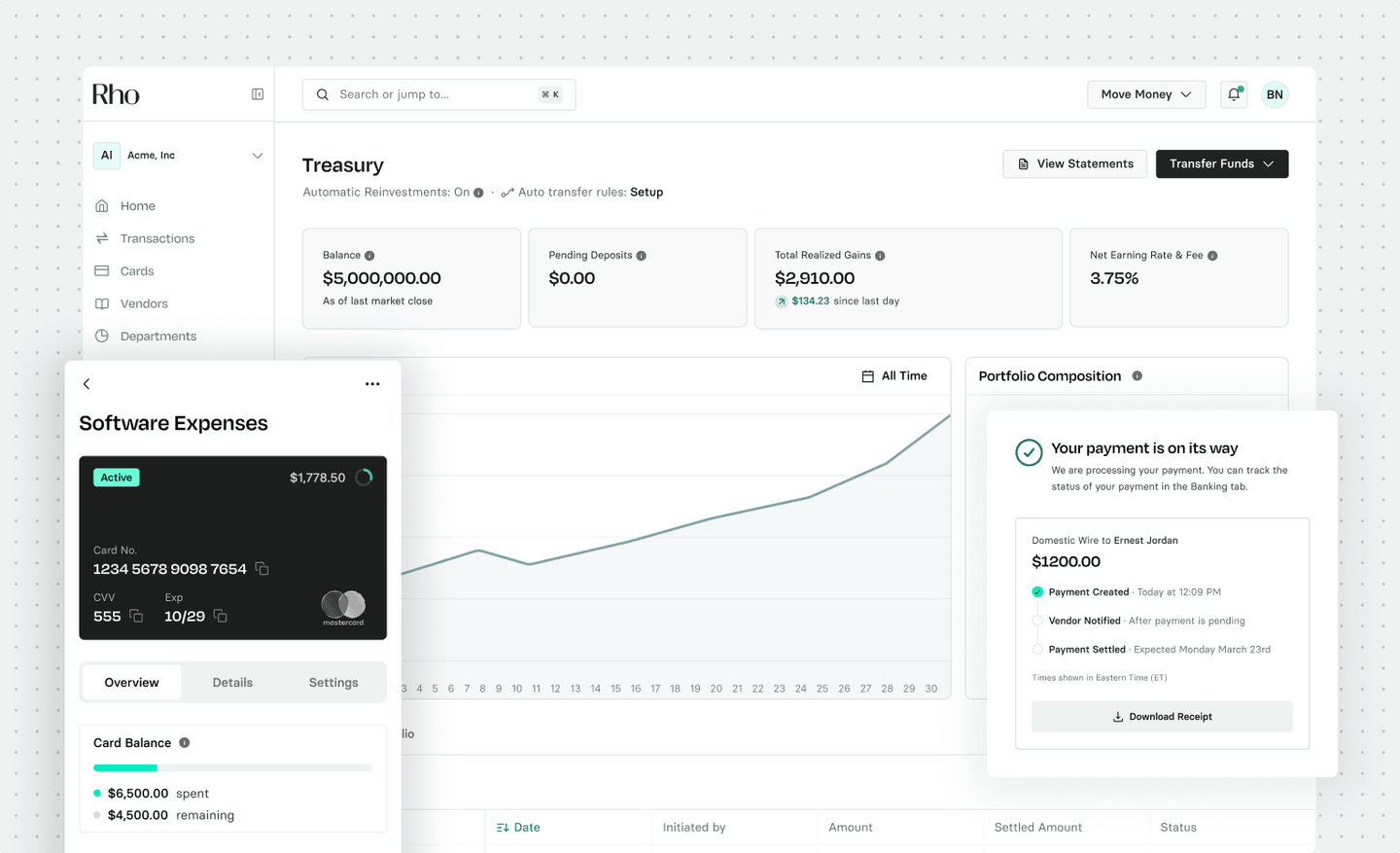
Based in New York, Rho is a business banking platform built for venture-backed startups -- from first raise to IPO. Rho combines business checking, corporate cards, bill pay, invoicing, expense management, and treasury in a single integrated platform with zero platform fees.
Best for: Venture-backed and venture-backable founders from incorporation through Series B and beyond. Rho is available through leading incorporation marketplaces, so founders can get set up in minutes as part of their early workflow -- before the first wire hits, before switching friction exists. Post-raise, operating cash moves into treasury to earn yield from day one. At 20+ employees, bill pay, native NetSuite sync, and multi-entity support are already built in. No platform fees at any headcount. No switching tools as the team grows.
Monthly fee | Minimum Opening Deposit | Overdraft Fees | Bonus |
|---|---|---|---|
None | None | N/A | None |
FDIC insured by: Checking account and card services are provided by Webster Bank, N.A., Member FDIC. Savings account services are provided by American Deposit Management Co. (ADM) and its partner banks, with up to $75M in FDIC insurance via a partner bank network (subject to FDIC limitations and requirements).
Integrations: QuickBooks Online, Oracle NetSuite, Sage Intacct, Puzzle, Campfire, and 50+ HRIS integrations. Flat-file CSV exporting is also supported.
How founders use Rho at each stage:
At incorporation: Open a Rho account in minutes through a leading incorporation marketplace -- account live before the first dollar moves, treasury access ready for when the pre-seed closes.
At first raise: The wire from the VC hits on a Tuesday. By Wednesday morning, operating cash is in treasury earning yield, virtual cards are live with spend limits, and the accounting sync is configured. No manual setup. No waiting.
At Series A and beyond: A 15-person SaaS team connects Rho directly to NetSuite -- eliminating manual month-end reconciliation. Bill pay handles vendor invoices end to end. The controller gets 4-6 hours a month back. No platform fees at any headcount.
Pros
Zero platform fees: No monthly platform fees at any stage or headcount.
Human support: Live support via in-app chat, email, and 24/7 phone (1-855-7-GETRHO).
Fully integrated stack: Checking, cards, bill pay, invoicing, expense management, and treasury in one platform -- no stitching tools together.
FDIC coverage: Up to $75M via ADM partner bank network -- the highest of any platform in this comparison.
Cons
Cashback only, no points: Rho offers straightforward cashback on corporate card spend. Founders who prefer travel points from Amex, Chase, or Capital One may want a supplementary card.
No cash deposit support: Rho doesn't accept cash deposits. For businesses that regularly handle physical cash, this is a hard constraint.
2. Bluevine
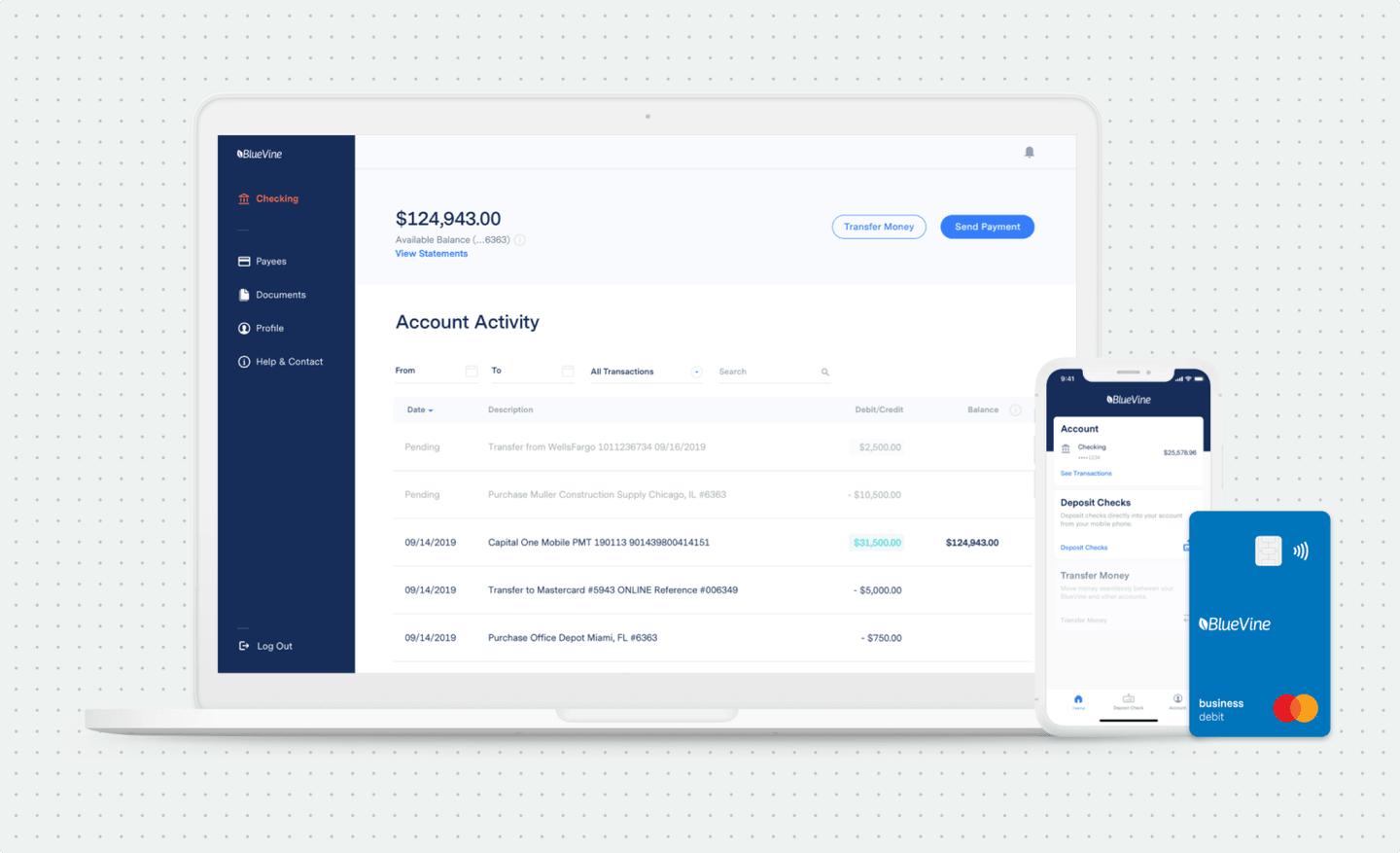
Bluevine provides business banking products, loans, and credit cards primarily to small and medium-sized businesses.
Best for: Small business owners who need low-cost checking with bill pay and basic AP functionality. Bluevine is not built for VC-backed startups that need integrated spend management, corporate cards, or treasury.
APY: Standard plan: 1.3% APY on balances up to $250,000, only if a monthly activity goal is met (spend $500+/month on a Bluevine debit or credit card, OR receive/deposit $2,500+/month in customer payments). If the goal is not met, APY is 0.00% for that month. Premier plan: 3.0% APY on all balances (no cap). Rates are variable and subject to change. As of April 14, 2026.
Monthly fee | Minimum Opening Deposit | Overdraft Fees | Bonus |
|---|---|---|---|
$0–$95 | None | None | None |
FDIC insured by: Coastal Community Bank, Member FDIC (up to $3M via sweep network).
Integrations: QuickBooks Online, QuickBooks Desktop.
Pros:
No monthly fees on the Standard plan
Up to $3M in FDIC insurance via Insured Cash Sweep
Sub-accounts for budgeting; revolving line of credit up to $250K
Cons:
Fees charged for cash deposits
Out-of-network ATM fees apply
No corporate credit cards — Bluevine offers business debit cards and a cashback debit Mastercard, not corporate charge or credit cards
Standard plan APY is conditional: 0% if monthly activity goals are not met
Bluevine vs. Rho: Bluevine is built for small business owners who primarily need checking and bill pay. It doesn't offer corporate credit cards, AP automation, or treasury management. For a funded startup managing vendor invoices, employee cards, and idle cash simultaneously, Bluevine's feature set stops well short of what's needed.
3. Wells Fargo
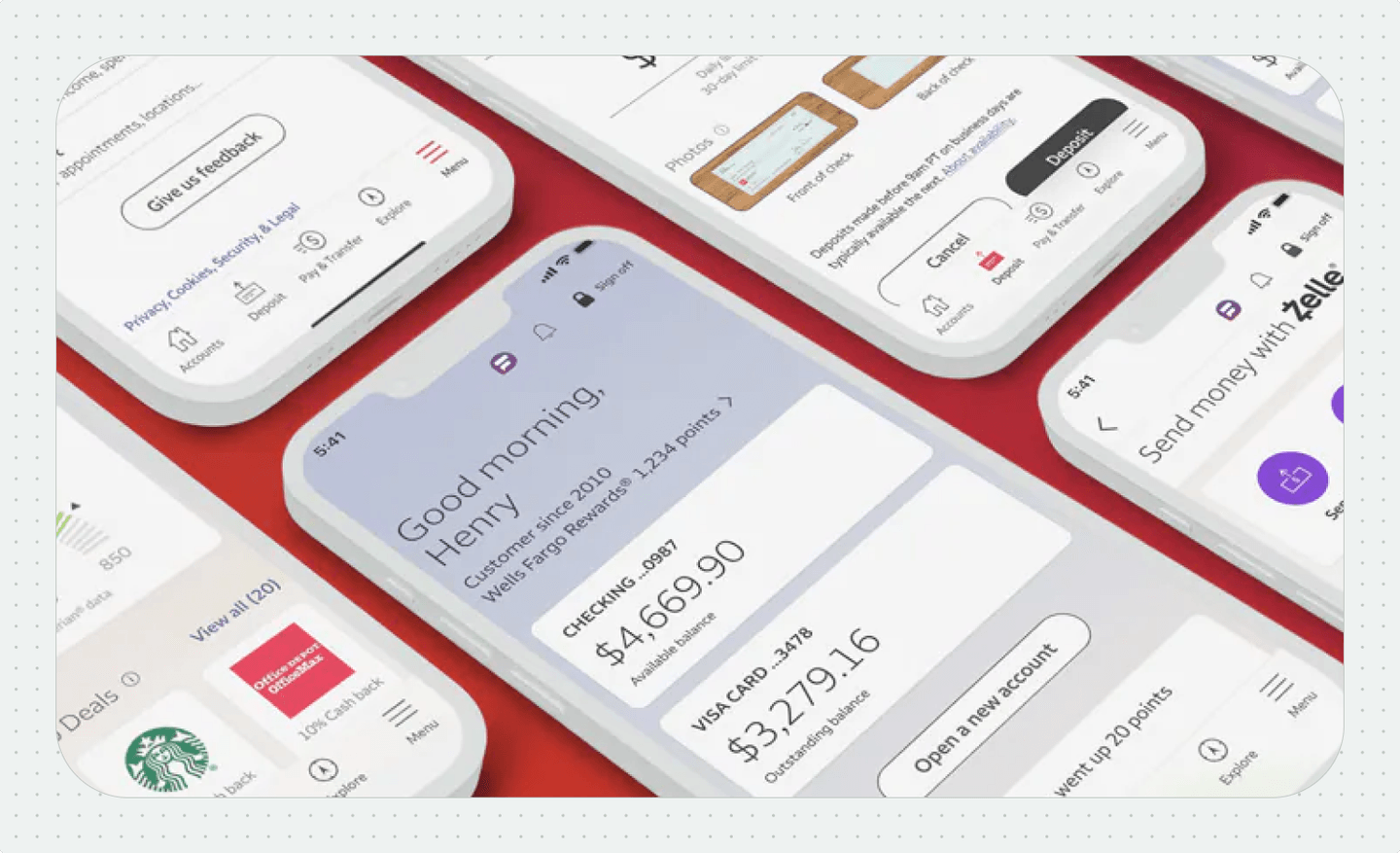
Wells Fargo is one of the largest U.S. banks, offering banking services, lending, investments and wealth management, and investment banking.
Best for: Startups that can generate enough activity to waive monthly fees, or founders who need SBA lending or merchant account services alongside their banking.
APY: Navigate Business Checking pays a variable APY. Other checking accounts pay no APY.
Monthly fee | Minimum Opening Deposit | Overdraft Fees | Bonus |
|---|---|---|---|
$10–$75 | $25 | $35 | None |
FDIC insured by: Wells Fargo Bank, N.A., Member FDIC.
Integrations: Xero and QuickBooks (via Web Connect — an extra step that slows reconciliation).
Pros:
Phone support available until 11pm EST on weekdays and on weekends
No ATM fees at 4,900+ branch locations
Easy to upgrade checking accounts as the business scales
Cons:
No free business checking account option
Transaction limits with fees above monthly thresholds
Wells Fargo vs. Rho: Wells Fargo offers several banking services but can be expensive for fast-moving startups. Rho provides a single platform with integrated checking, cards, AP automation, and treasury — no platform fees, more seamless ERP integrations.
4. Bank of America
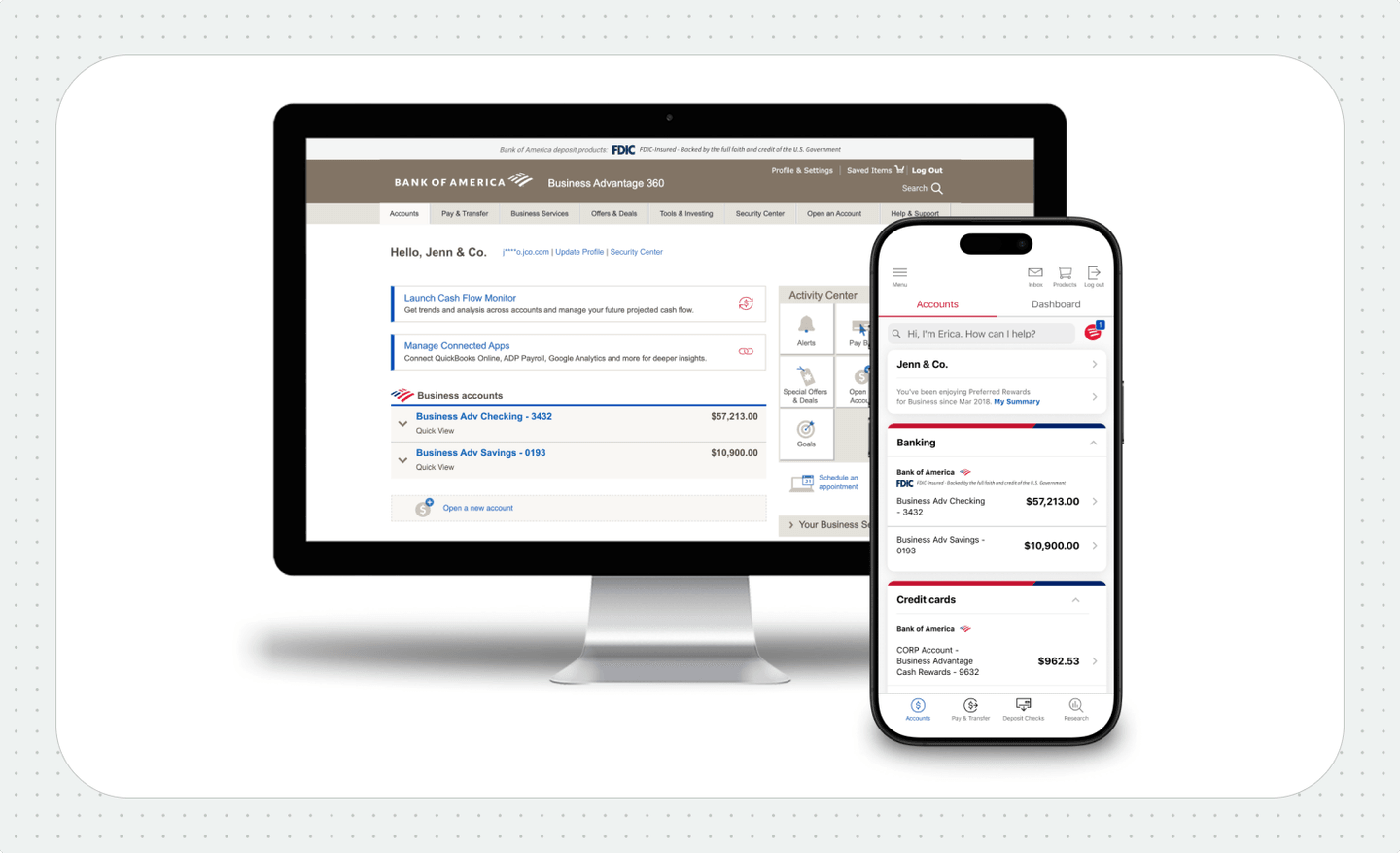
Bank of America offers checking and savings, credit cards, bill pay, startup-friendly lending, and investing tools.
Best for: Startups that want a national bank with broad financial services and can meet balance requirements to minimize fees.
Monthly fee | Minimum Opening Deposit | Overdraft Fees | Bonus |
|---|---|---|---|
$16–$29.95 | $100 | $10 | None |
FDIC insured by: Bank of America, N.A., Member FDIC.
Integrations: QuickBooks.
Pros:
No fees for electronic transactions
Higher cash deposit limits than most competitors
Business accounts can be opened entirely online
Cons:
Monthly fees on all checking tiers
$100 minimum to open an account
Out-of-network ATM fees
Bank of America vs. Rho: BofA offers more digital capability than most legacy banks, but monthly and transaction fees add up quickly for fast-growing startups. Rho doesn't charge platform fees and offers a more integrated stack for startup finance teams.
5. JP Morgan Chase
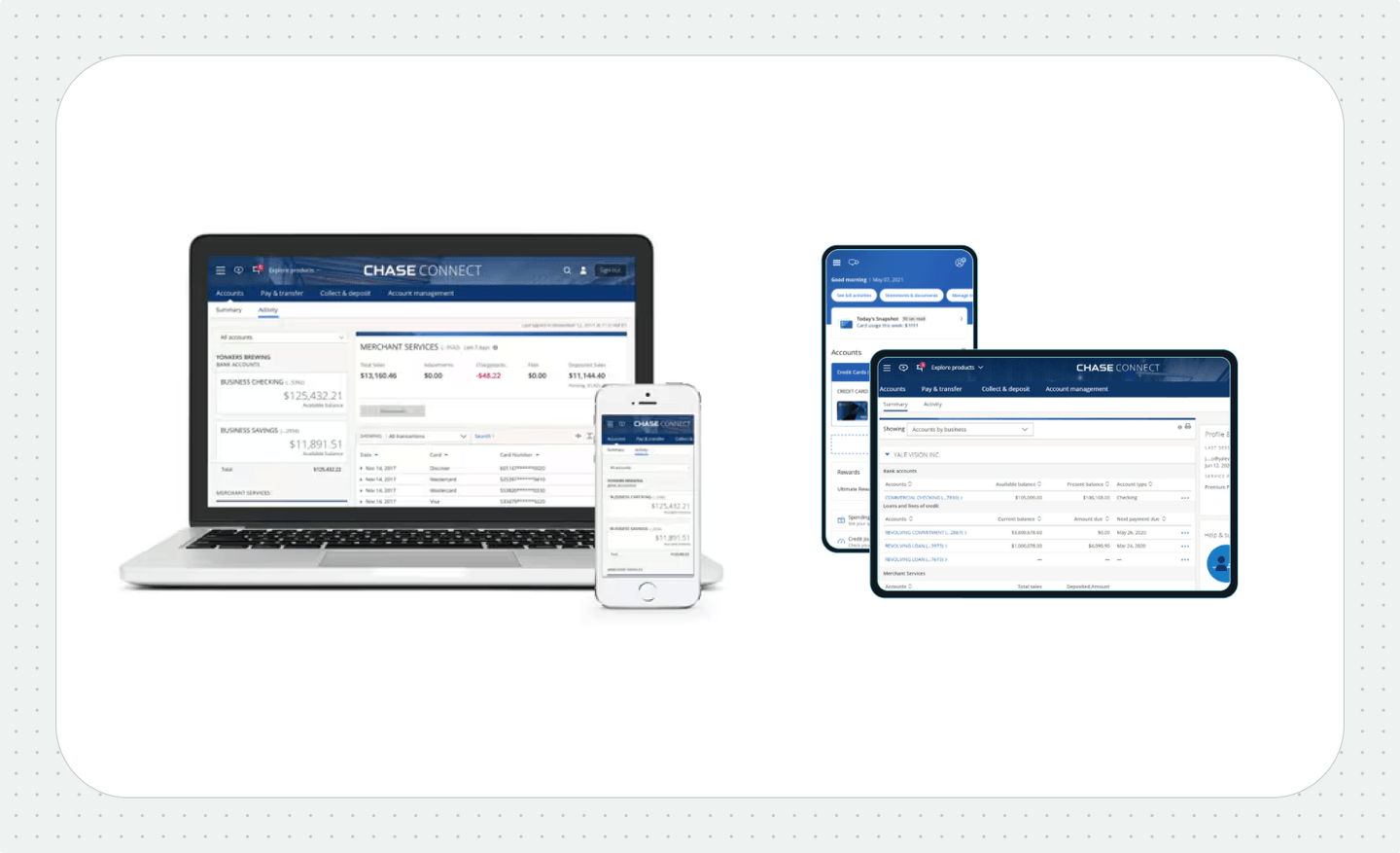
Chase for Business offers bank accounts, small business loans, business credit cards, and other financial services.
Best for: Startups that want a national bank relationship with access to lending, or companies that need extensive ATM and branch coverage.
Monthly fee | Minimum Opening Deposit | Overdraft Fees | Bonus |
|---|---|---|---|
$15–$95 | $2,000 | $34 | None |
FDIC insured by: JP Morgan Chase Bank, N.A., Member FDIC.
Integrations: QuickBooks Online.
Pros:
Well-known national brand; thousands of ATM and branch locations
Access to credit products (lines of credit, loans) as the business grows
Cons:
Monthly service fees and non-Chase ATM fees
Monthly cap on fee-free cash deposits ($5,000) and physical transactions (20)
No integrated finance automation tools
JP Morgan Chase vs. Rho: Chase fees accumulate quickly — monthly account fees, transaction fees, cash deposit fees. Rho doesn't charge platform fees and offers an integrated financial stack designed for startup operations.
6. Mercury
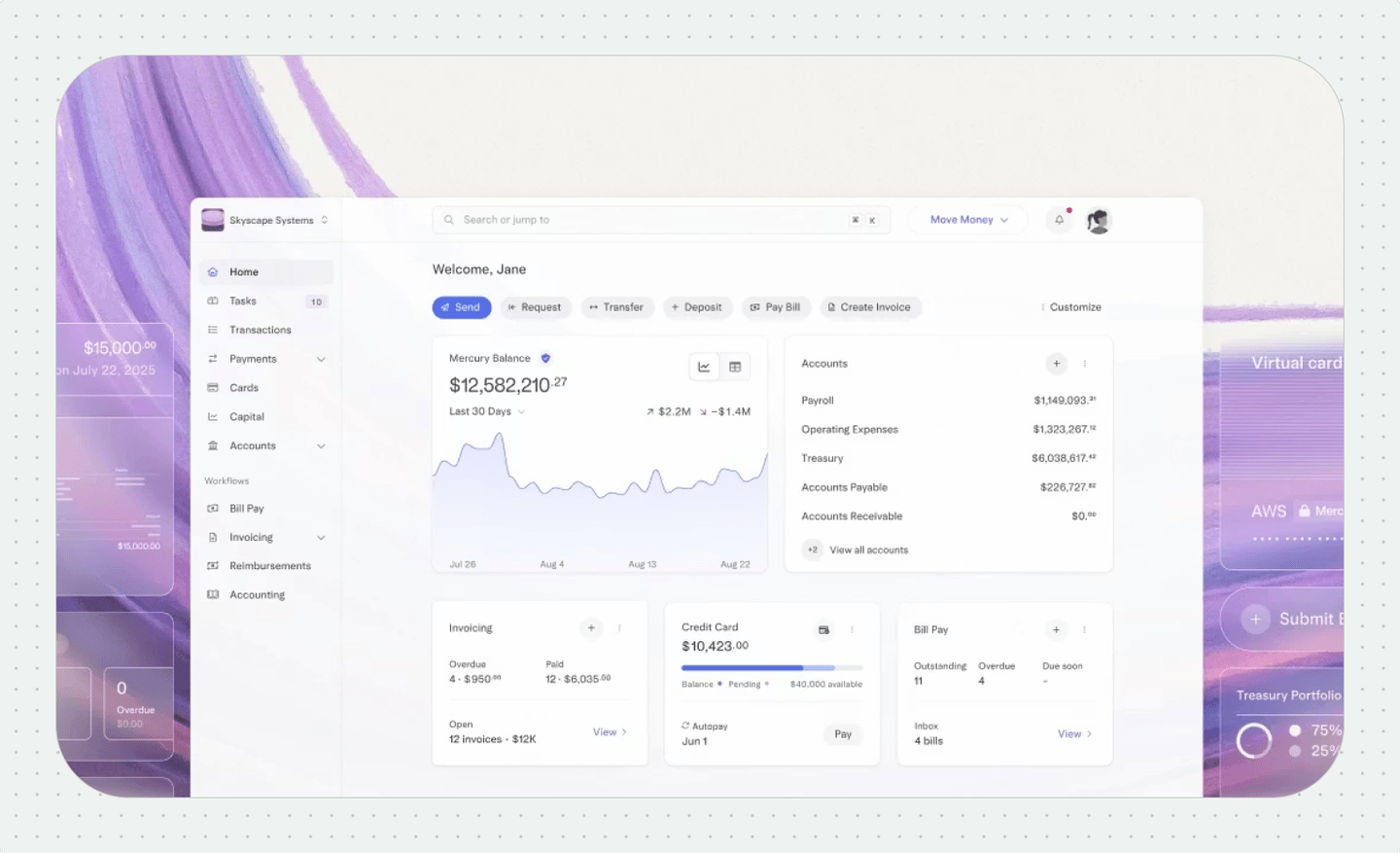
Mercury is a fintech platform offering business checking, savings, corporate cards, treasury, and venture debt to VC-backed startups. It's one of the two most widely used startup banking platforms, alongside Rho, and is the default choice for many first-time founders coming out of accelerators.
Best for: Early-stage founders who want a simple, clean banking experience and don't yet need integrated bill pay, native ERP connections, or phone support.
Monthly fee | Minimum Opening Deposit | Overdraft Fees | Bonus |
|---|---|---|---|
None | None | None on checking | None |
FDIC insured by: Choice Financial Group, Column N.A., and Evolve Bank & Trust, Members FDIC (up to ~$5M via partner banks).
Integrations: QuickBooks and Xero; NetSuite categorizations available on Pro plan ($299/mo) only -- not a native bidirectional sync.
Note: On April 27, 2026, Mercury received conditional OCC approval to establish Mercury Bank, N.A. Final authorization from the FDIC and Federal Reserve is still pending, with no confirmed timeline. Mercury continues operating through its existing partner bank structure in the interim. Mercury's CEO confirmed the charter is needed to unlock capabilities including Zelle, expanded lending, and deeper payment infrastructure -- features that aren't available to customers today.
Pros:
No account minimums, overdraft fees, or monthly fees
Clean, intuitive platform with strong brand recognition in the startup ecosystem
Access to corporate cards, treasury, and venture debt
Built-in bill pay with AI-powered data extraction on paid tiers
Cons:
Advanced features are paywalled: multiple GL codes require Plus ($29.90/mo); NetSuite categorizations and a dedicated relationship manager require Pro ($299/mo)
Expense reimbursements capped at 20 users/month on Plus; additional users cost $5/month each
No phone support -- chat only, weekend availability unconfirmed
FDIC coverage capped at ~$5M -- meaningful gap for post-raise startups holding $1M+
Currently in a regulatory transition period, with product capabilities and partner bank structure subject to change pending charter approval
Mercury vs. Rho: Both platforms are built for startups and share a similar ICP. Mercury has a head start on brand recognition and wins on first-impression simplicity. The meaningful differences emerge as teams grow: Mercury's full feature set is gated behind paid plans that reach $299/mo, it has no phone support on any free tier, and its FDIC coverage is roughly 15x lower than Rho's. For founders who want the complete stack -- bill pay, invoicing, expense management, native NetSuite sync, and treasury -- working together from day one with no platform fee, Rho is the stronger long-term fit. See our full comparison of Rho and Mercury here.
7. Brex
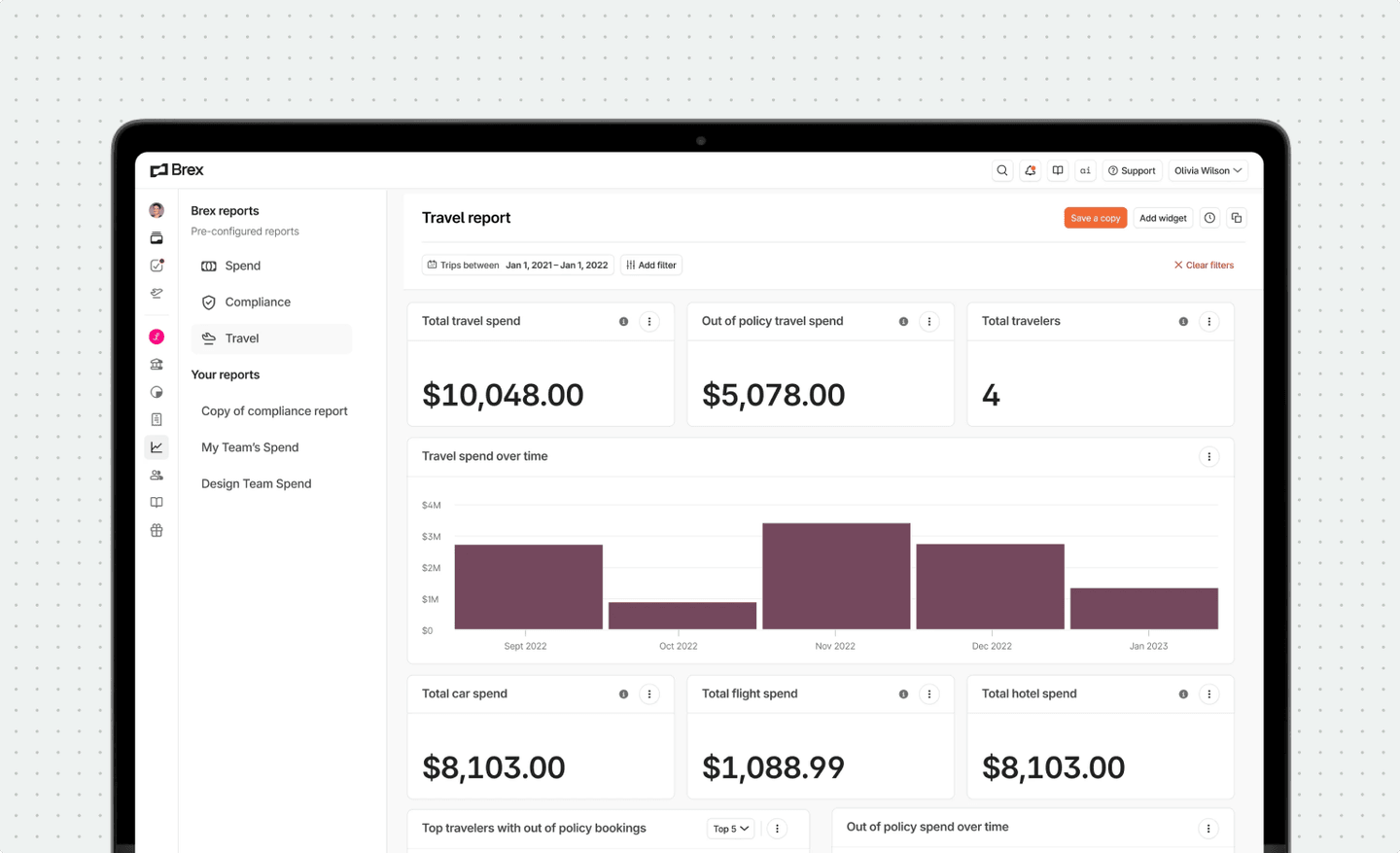
Brex started as a corporate card provider and has since expanded into business checking, treasury, travel, and AI-powered expense management.
Best for: Enterprise-scale companies with distributed international teams that need multi-currency payments and AI-driven spend automation — and are willing to pay per-user pricing for premium support and advanced features.
Who should look elsewhere: Startups that don't want per-user pricing, don't need global payments in 40+ currencies, or want phone support without paying $12/user/month. Brex's Essentials tier has documented support delays. The full product is priced and designed for enterprise, not early-stage.
Monthly fee | Minimum Opening Deposit | Overdraft Fees |
|---|---|---|
$0–$12/user | None | None |
APY: No APY on checking; customers can invest in money market funds through Brex Treasury.
FDIC insured by: Column N.A., Member FDIC (checking); Emigrant Bank and Fifth Third Bank, N.A. (credit card); up to $6M via partner bank vault.
Integrations: NetSuite, QuickBooks, and others.
Pros:
Comprehensive platform: checking, treasury, cards, expense management, and travel in one place
Global payments in 40+ currencies; strong fit for internationally distributed teams
AI-powered expense automation and approval workflows
Cons:
Dedicated customer support requires Premium ($12/user/month) or Enterprise; Essentials users report slow response times
Advanced features, including custom budgets, reporting, and travel, require a paid tier
Credit limits can decrease when bank balances drop, sometimes without clear notice
No longer serves non-venture-backed small businesses
Brex vs. Rho: Brex is an enterprise spend platform that startups can use. Rho is a startup banking platform built specifically for the seed-to-Series B journey. The difference shows up in pricing (no per-user fees), support (24/7 phone without a premium tier), and FDIC coverage ($75M vs. $6M) — not in feature count. See our full comparison of Rho and Brex here.
8. Axos
Axos Bank is a full-service online bank offering checking, savings, CDs, merchant services, treasury, and commercial loans.
Best for: Startups that process significant cash transactions and want ATM cash deposit access.
APY: Business Interest Checking: up to 1.01% APY. Basic Business Checking: no APY.
Monthly fee: Basic Business Checking is free. Business Interest Checking: $10/month (waived with $5,000 average daily balance).
Minimum opening deposit: None (Basic); $100 (Interest Checking).
Overdraft fees: $25.
Bonus: $400 when opening a new Axos business account and maintaining $50,000 average daily balance.
FDIC insured by: Axos Bank, Member FDIC.
Integrations: QuickBooks only.
Pros:
Cash deposits available via MoneyPass and AllPoint ATMs; ATM fees refunded automatically
24/7 customer support
No monthly fees on Basic tier
Cons:
No third-party integrations beyond QuickBooks
$25 fee for insufficient funds
Axos vs. Rho: Axos handles cash transactions well but offers no automation or integrations beyond QuickBooks. Rho provides a full integrated stack — banking, cards, AP, expense management, treasury — without add-on software or platform fees.
9. US Bank
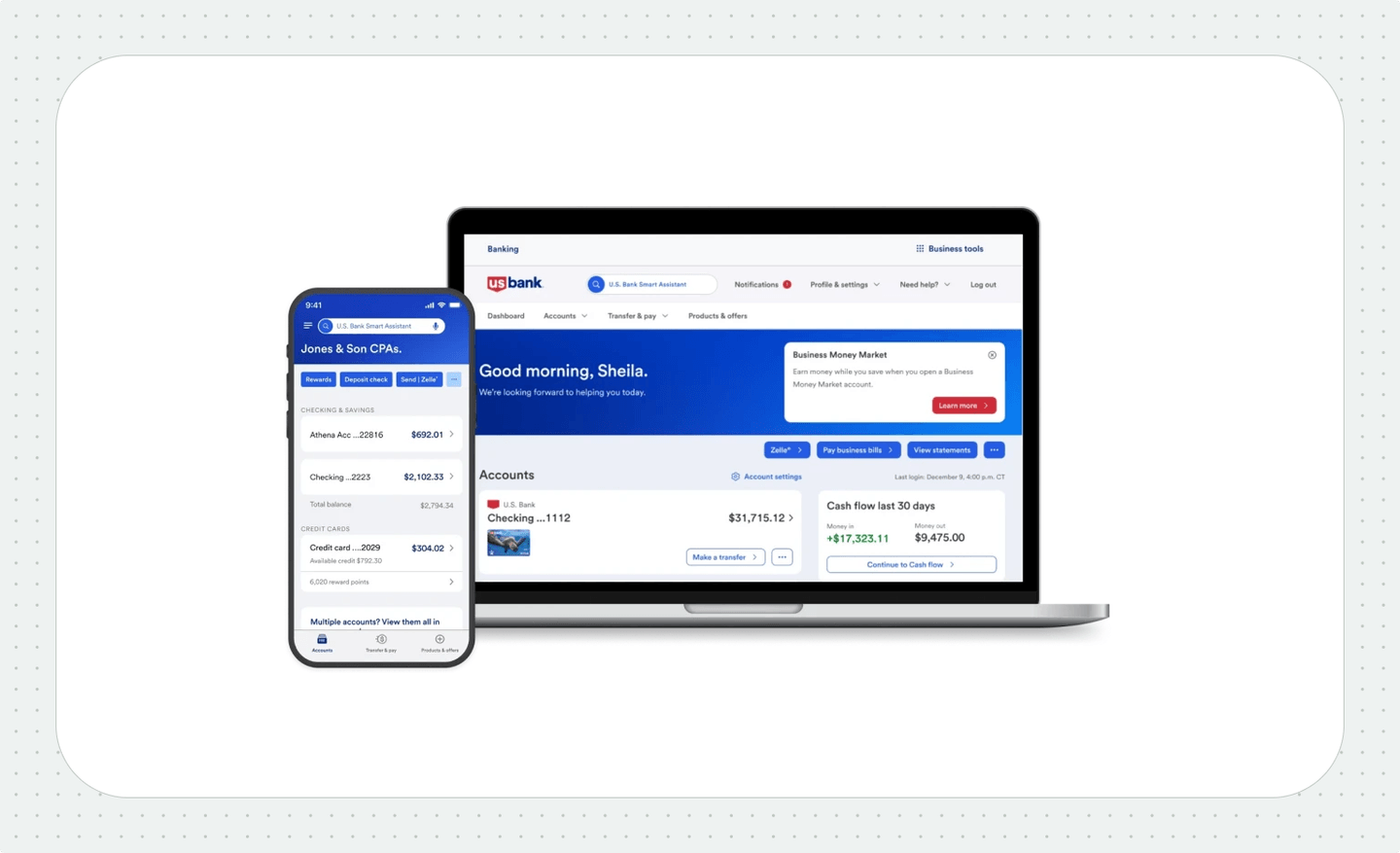
US Bank is the fifth-largest bank in the U.S., offering banking, wealth management, and commercial loan services.
Best for: Startups with low monthly transaction volume that want a no-fee national bank account and a welcome bonus.
Monthly fee | Minimum Opening Deposit | Overdraft Fees |
|---|---|---|
None | None | $100 |
Free cash deposits: Up to $2,500/month.
Overdraft fees: No fee if overdrawn $50 or less; $36 fee for larger amounts.
Bonus: Up to $800 when opening a new eligible U.S. Bank business checking account online and completing qualifying activities.
FDIC insured by: U.S. Bank National Association, Member FDIC.
Integrations: QuickBooks Online.
Pros:
No monthly service fees on Silver Business Checking
No fees at US Bank ATMs and branches
Cons:
Low cash deposit limits ($2,500/month free)
Fee-free transactions capped at 125/month
Fees for outgoing domestic ACH transfers
US Bank vs. Rho: US Bank's Silver account is fee-friendly at low transaction volumes, but growing startups hit limits quickly. Rho offers a fully integrated platform with no platform fees and broader ERP integrations.
10. Grasshopper
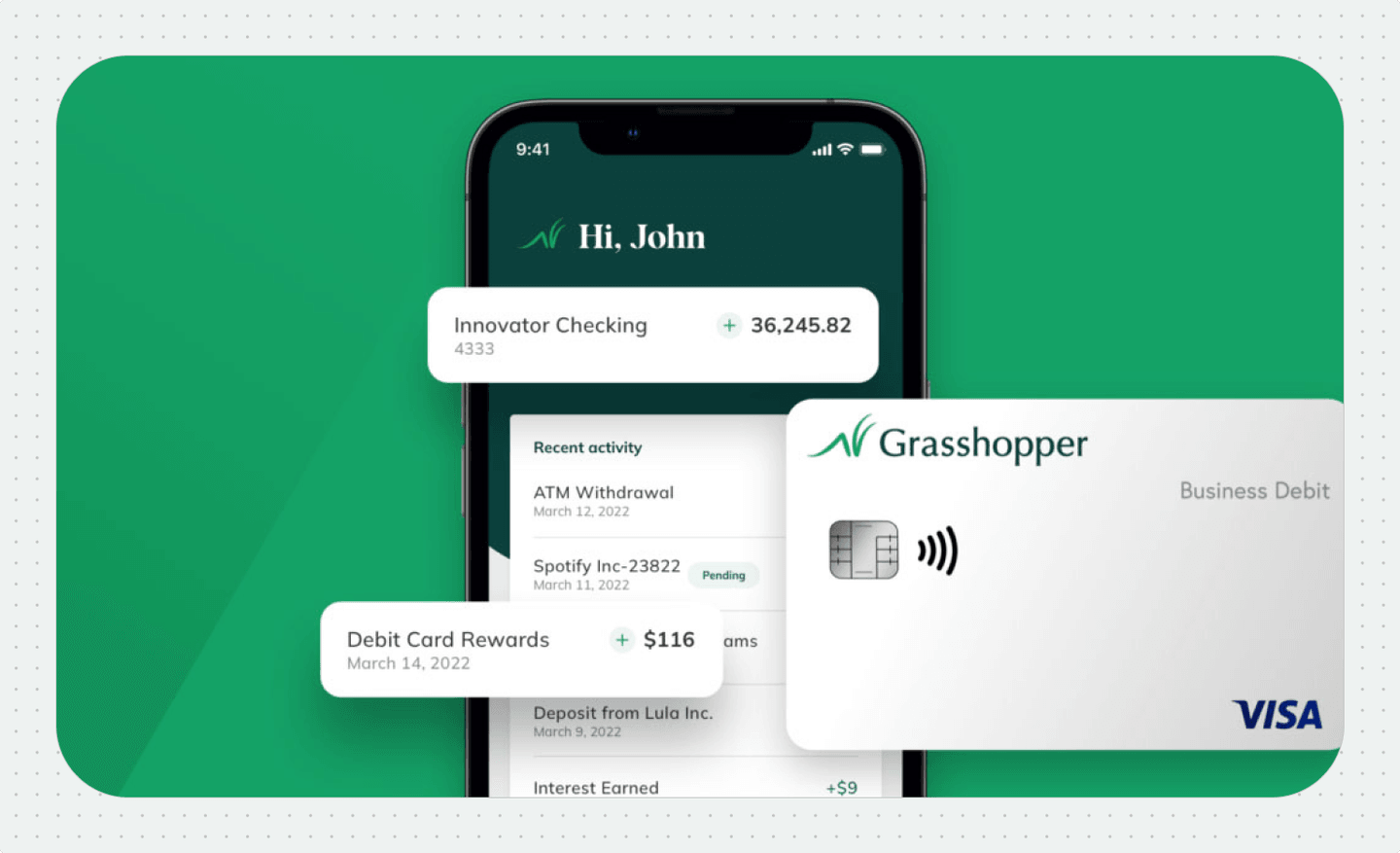
Grasshopper provides banking products specifically to small businesses and VC-backed startups, including lending services.
Best for: Seed and Series A venture-backed startups (with some industry restrictions) that want a high-APY checking account with no monthly fees.
Monthly fee | Minimum Opening Deposit | Overdraft Fees |
|---|---|---|
None | $100 | None |
APY: Up to 1.51% APY on balances up to $25,000; up to 2.25% APY on $25,000–$250,000.
FDIC insured by: Grasshopper Bank, Member FDIC (up to $250,000).
Integrations: QuickBooks Online and QuickBooks Desktop.
Pros:
1% unlimited cashback on qualified debit card purchases
High APY for a checking account
No monthly fees or overdraft charges
Cons:
No cash deposits
No weekend customer support
No AP automation, spend management, or treasury tools
Grasshopper vs. Rho: Grasshopper provides solid early-stage startup banking with an attractive APY. As operations grow, founders need AP automation, spend controls, and multi-entity support. Rho's integrated platform covers those needs without requiring a switch.
11. Live Oak Bank
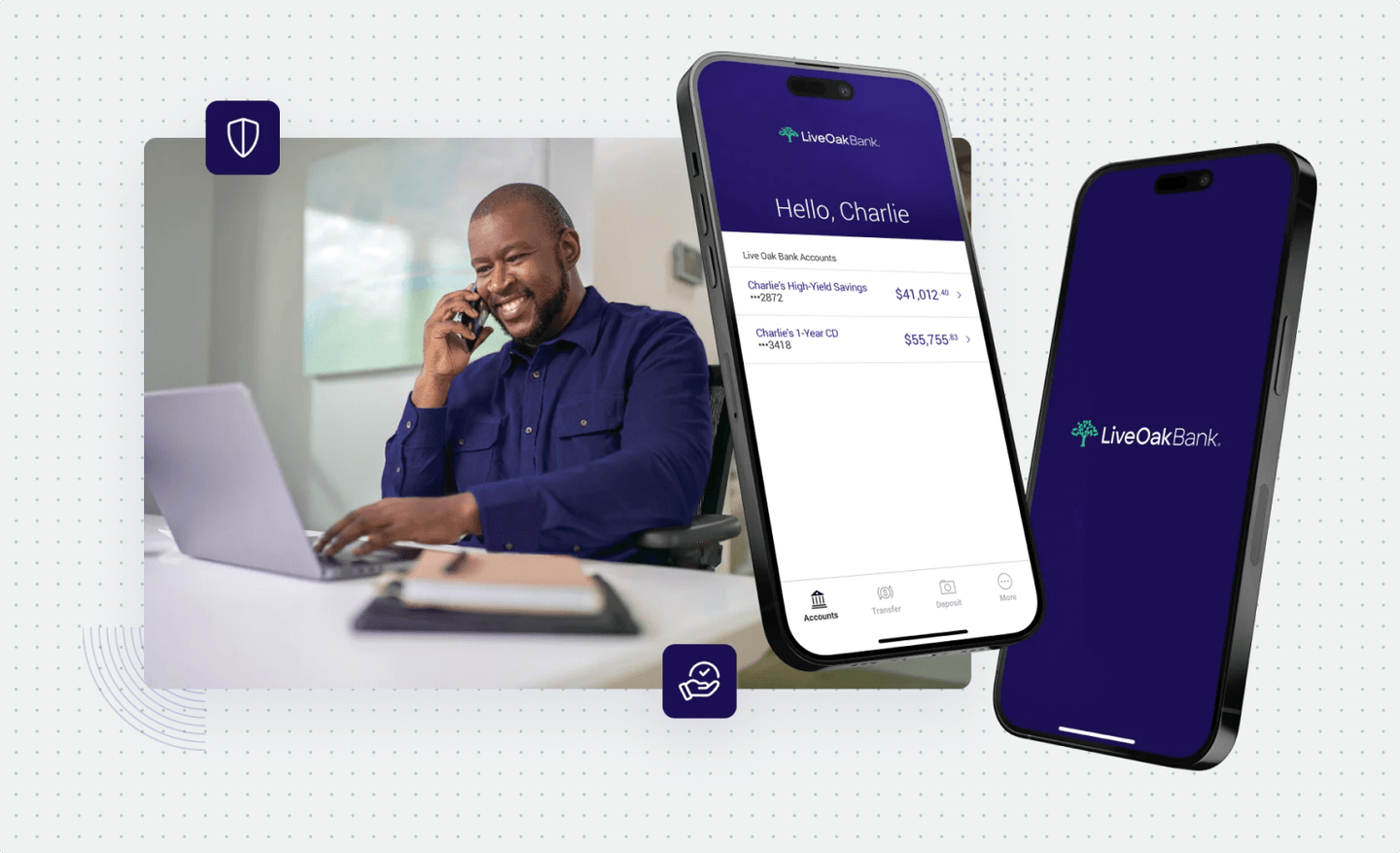
Live Oak Bank offers checking, savings, CDs, and several business loan types, with three checking account tiers:
Business Essential: $10/month (waived with $1,000 average daily balance); $25 overdraft fee
Business Plus: $25/month (waived with $25,000 average daily balance); $25 overdraft fee
Business Plus Analysis: $100/month (earnings credit can offset fees); no overdraft fees
Best for: Startups that want to invest excess cash at high yield in savings, or founders exploring SBA lending options.
APY: 4.00% APY on all savings account balances. No APY on checking.
FDIC insured by: Live Oak Bank, a subsidiary of Live Oak Bancshares, Inc. (NYSE: LOB), FDIC-insured.
Integrations: QuickBooks Online.
Pros:
Higher savings APY than most competitors with no minimum balance requirement
Monthly fees can be waived or offset by earnings credits
Cons:
Debit cards cannot be used at ATMs
No weekend customer support
Live Oak Bank vs. Rho: Live Oak is a good option for startups earning yield on excess savings. Founders who want a fully integrated stack — checking, cards, AP automation, and treasury in one place — should choose Rho.
 Meow is a business banking platform focused on helping startups earn yield on cash through money market funds and U.S. Treasury Bills held in custody at BNY Mellon Pershing.
Best for: Cash-heavy startups comfortable making their own investment decisions and seeking maximum FDIC coverage on large balances.
Monthly fee | Minimum Opening Deposit | Overdraft Fees | Bonus |
|---|---|---|---|
$10 | None | None | None |
APY: Up to 5.02% APY by meeting deposit minimums.
FDIC insured by: Grasshopper Bank, N.A., and Third Coast Bank SSB, Members FDIC (up to $125M via partner network).
Integrations: QuickBooks, Xero, NetSuite, and Sage.
Pros:
Very high FDIC coverage ceiling for large-balance startups
Fast cash withdrawals
Configurable user and approver settings
Cons:
Investment decisions are fully self-serve — you must manage your own portfolio
No integrated spend management, expense tools, or corporate cards
Meow vs. Rho: Meow's treasury is self-directed — you make investment decisions on your own. Rho's treasury operates on a policy you set, without requiring you to manage it. For startups that want yield without becoming their own treasury desk, Rho is the better fit.
13. North One
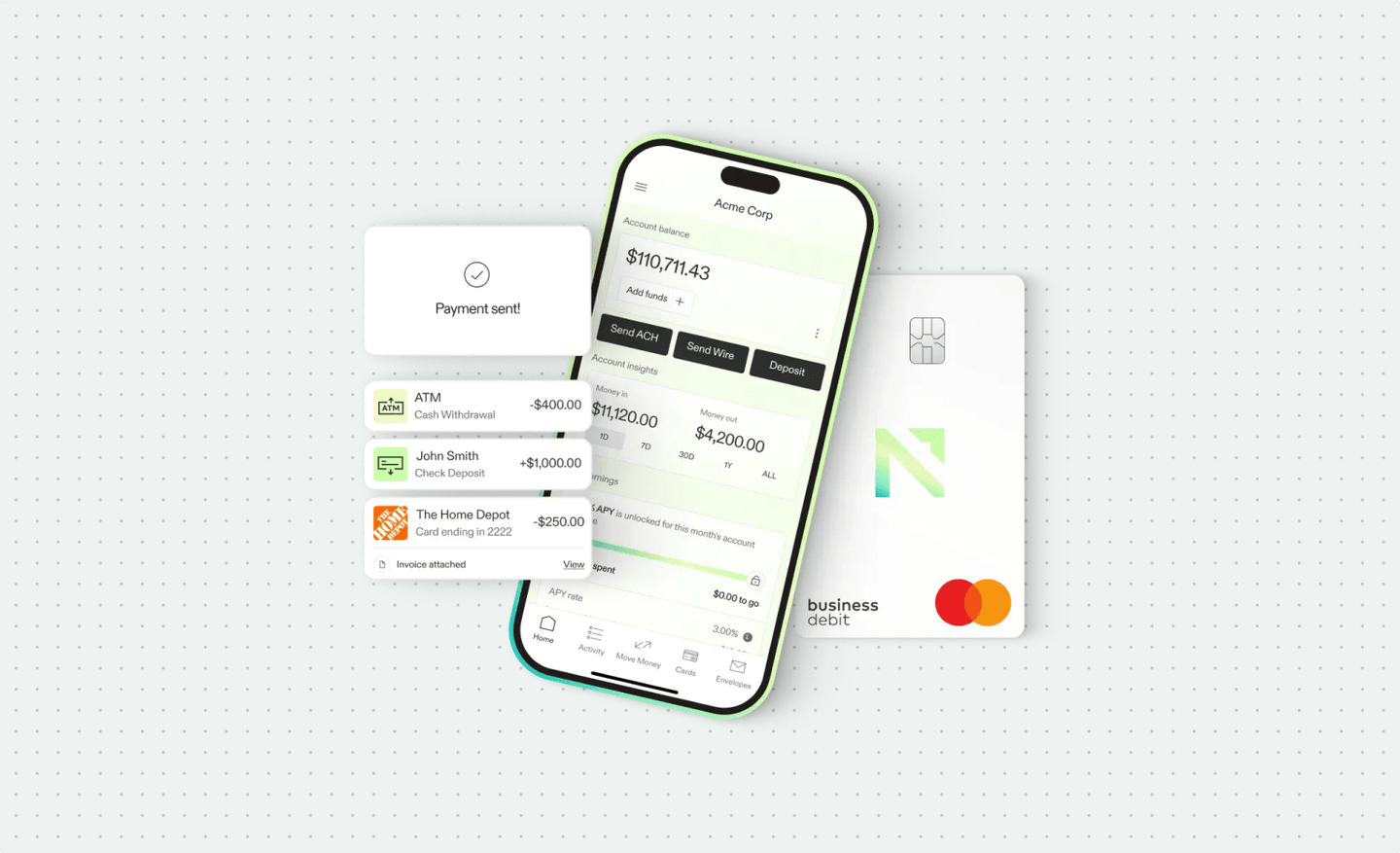
North One provides a business banking platform integrated with bill payment and bookkeeping tools, plus lending services.
Best for: Freelancers, contractors, and solo business owners who need business banking, bill payment, and basic accounting integrations.
Monthly fee | Minimum Opening Deposit | Overdraft Fees | Bonus |
|---|---|---|---|
None | $50 | None | None |
Monthly fee: Standard account is free; Plus account is $20/month (includes priority support and a dedicated relationship manager).
FDIC insured by: The Bancorp Bank, N.A., Member FDIC (up to $250,000).
Integrations: QuickBooks Online, QuickBooks Desktop, Sage, FreshBooks.
Pros:
Cash deposits at retail locations (Walmart, Walgreens, CVS, Rite Aid, 7-Eleven)
Integrated with bill payment and several accounting providers
Phone, email, and live chat support
Cons:
$20/month for the Plus tier
No treasury services or integrated financial stack
ATM fees for out-of-network use
North One vs. Rho: North One covers the basics for solo operators, but lacks the treasury, corporate cards, and spend management that growing startups need. Rho offers a fully integrated solution with no platform fees.
14. Novo
Novo provides checking accounts, debit cards, and invoice processing for small business finances.
Best for: Freelancers, contractors, and solo operators with straightforward banking needs. Not designed for startups that need wire transfers or phone support.
APY | Monthly Fee | Minimum Opening Deposit | Overdraft Fees |
|---|---|---|---|
None | None | None | None |
FDIC insured by: Middlesex Federal Savings, Member FDIC (up to $250,000).
Integrations: QuickBooks and Xero.
Pros:
No monthly fees, overdraft fees, or minimum balances
All ATM fees refunded
Cons:
Cannot send domestic or international wire transfers
No phone customer support
No cash deposits
Novo vs. Rho: Novo is a functional free banking option for the smallest operators. For startups that need wires, phone support, or any spend management beyond basic debit, Rho is the stronger fit — with no platform fees.
15. Relay
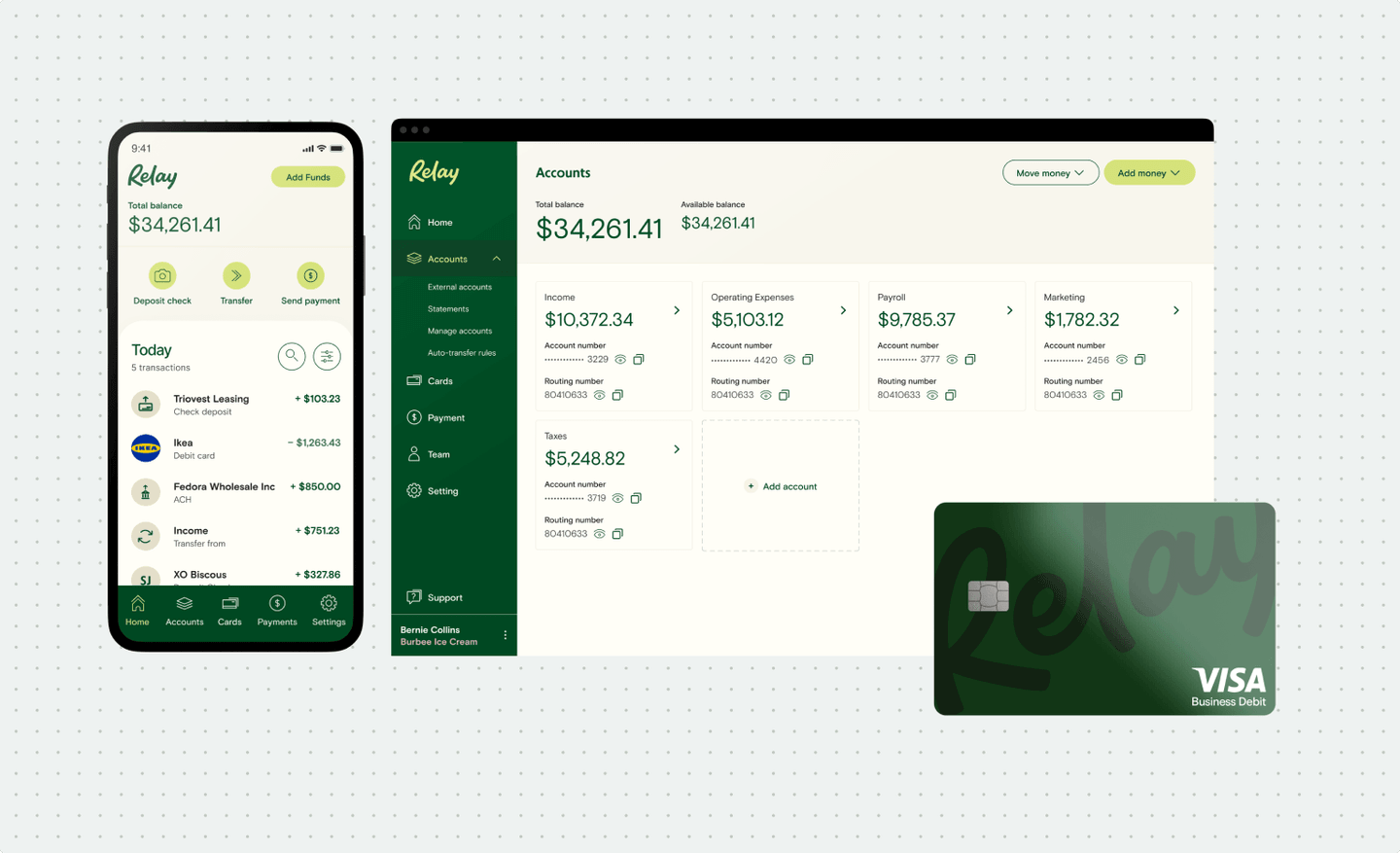 Relay provides business checking, savings, AP processing, and receipt management.
Best for: Small businesses that want to manage cash across multiple accounts with clear budget segmentation. Note: Relay holds deposited checks for 6–7 business days.
APY: 1.00%–3.00% APY depending on total savings balance.
Monthly fee: Free (standard); $30/month for Relay Pro (adds same-day ACH and free outgoing wire transfers).
Minimum opening deposit: None.
FDIC insured by: Thread Bank, Member FDIC (up to $250,000).
Integrations: QuickBooks Online and Xero.
Pros:
Up to 20 checking accounts under one profile
No monthly fees or overdraft fees on standard plan
Cash deposits via AllPoint ATMs
Cons:
No weekend customer support
6–7 business day check hold
Bill payment only available on Relay Pro ($30/month)
Relay vs. Rho: Relay handles multi-account cash segmentation well for small businesses. For startups that need corporate cards, treasury, and integrated expense management, Rho offers a more complete platform at no platform fee.
16. Arc
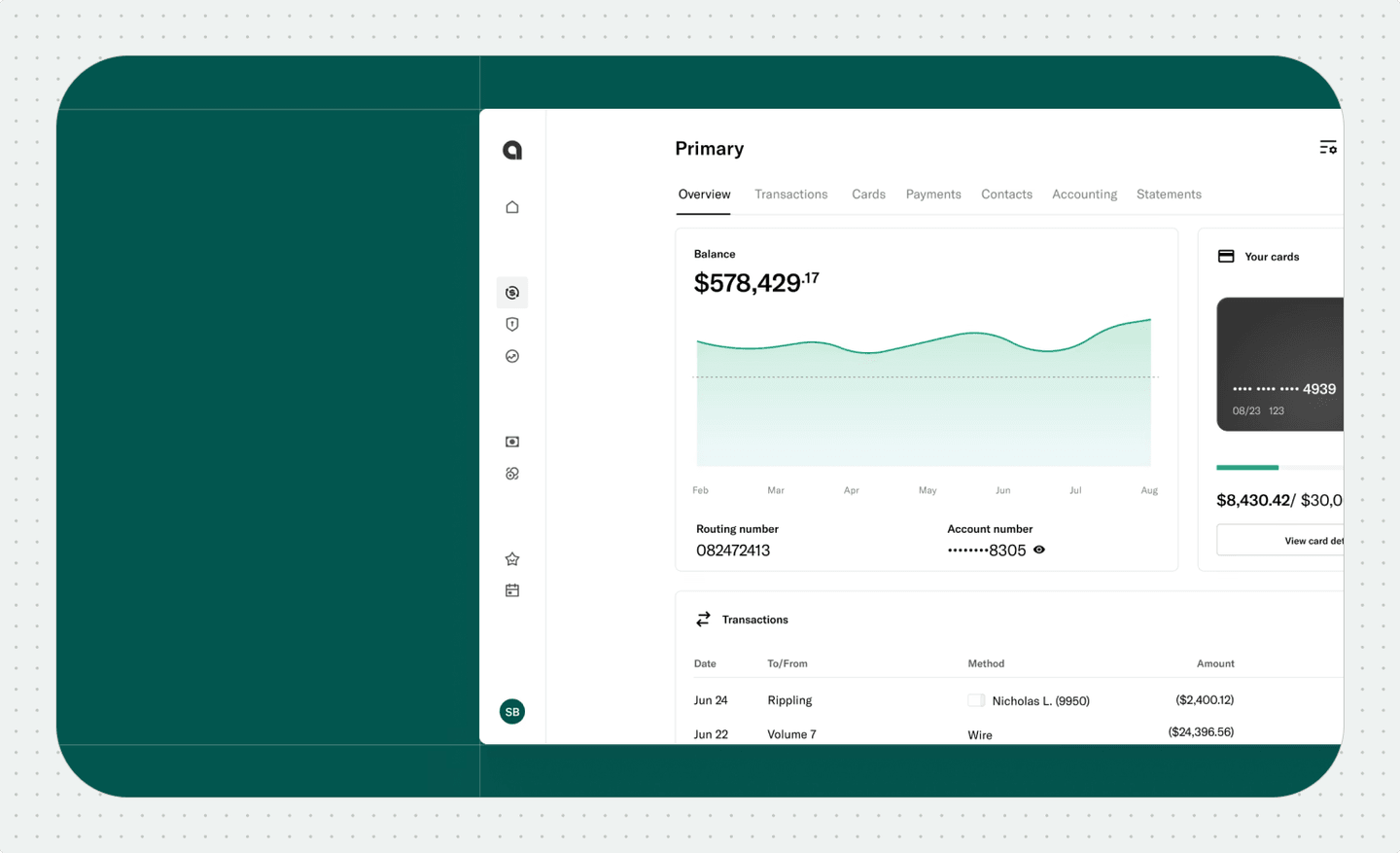
Arc provides startup cash management, including payment management, treasury services, and financing, with investments through BNY Mellon Pershing.
Best for: Founders focused on yield optimization who want auto-balancing between operating and treasury accounts and broad FDIC coverage on larger balances.
APY: No APY on Arc Operating (checking); 4.00% APY on Arc Reserve (savings).
Monthly Fee | Overdraft Fee | Bonus |
|---|---|---|
None | None | None |
FDIC insured by: Evolve Bank and Trust, FDIC-insured (up to $5.5M via partner network; $500K SIPC coverage also available).
Integrations: QuickBooks.
Pros:
Dedicated on-call relationship manager
Recurring vendor payments can be scheduled in the operating account
Cons:
No mobile app
Operating accounts earn no interest
Standard treasury account lacks automated cash balancing
Arc vs. Rho: Arc's lack of a mobile app and limited automation are real friction points for fast-moving startup teams. Rho offers treasury management integrated with AP, expense management, and banking — plus a mobile app — with no platform fees.
17. Ramp
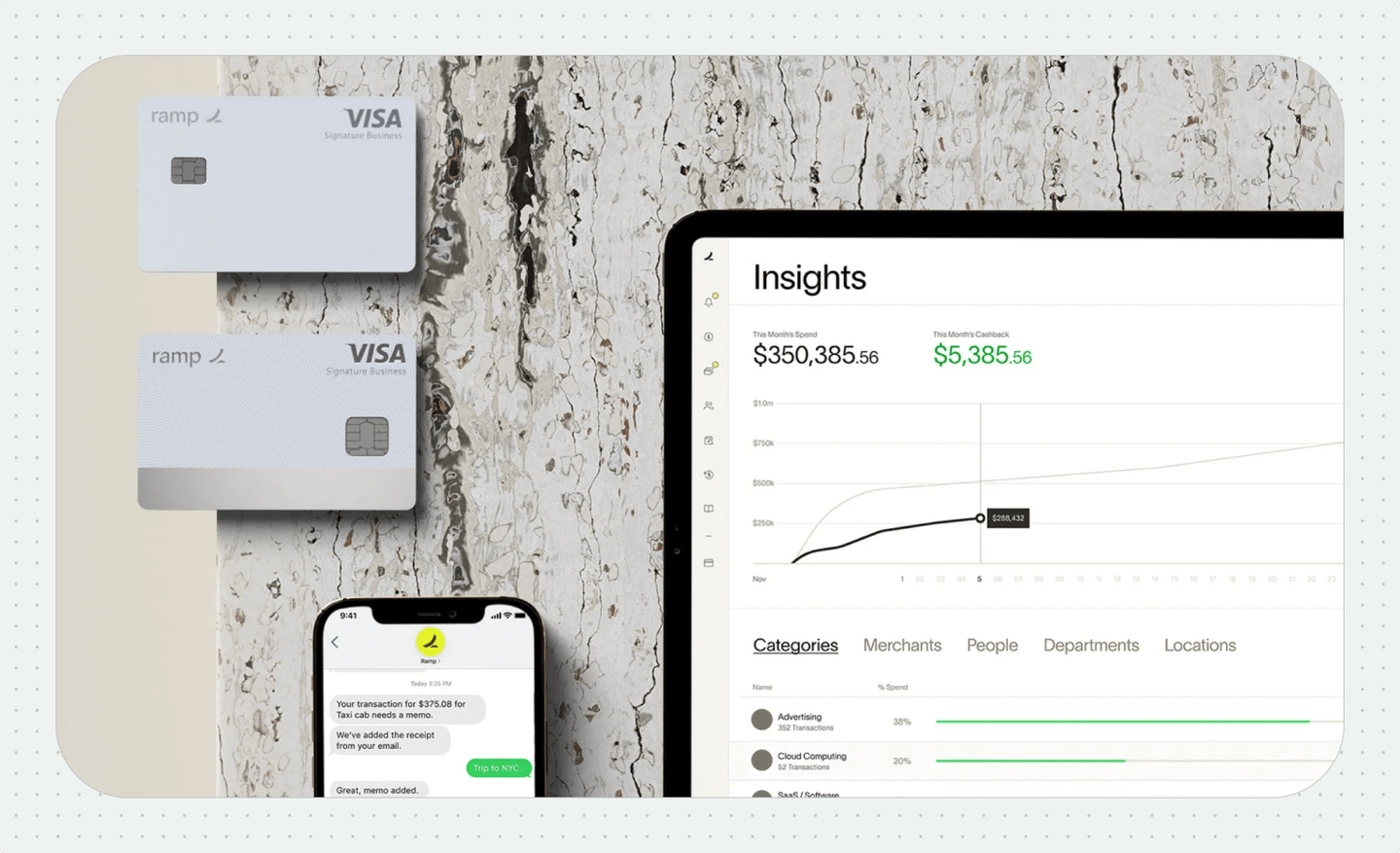
Ramp is a finance automation platform that has expanded significantly beyond corporate cards and expense management. In January 2025, Ramp launched Ramp Treasury — a cash management suite that includes a business deposit account, a self-directed investment account (money market fund), and a Managed Investment Account with professionally managed fixed-income portfolios. All three products are integrated directly into Ramp's AP and spend management workflows.
Best for: Businesses that want an integrated spend management and banking solution with no base fees, strong accounting integrations, and increasingly sophisticated treasury options — including managed fixed-income portfolios for larger cash balances.
Ramp Treasury — three products:
Ramp Business Account — FDIC-insured deposit account through First Internet Bank of Indiana, Member FDIC. Earns a variable interest rate paid by First Internet Bank. FDIC coverage up to tens of millions of dollars per depositor via IntraFi Network LLC (ICS) sweep network. No account fees, no minimums, no transfer caps. Supports free same-day ACH and wire payments when paying bills through Ramp. Earns on the first dollar — no cap.
Ramp Investment Account (Self-Directed) — Invests in FUGXX (Invesco Premier U.S. Government Money Portfolio), a money market fund investing in short-term U.S. Treasury obligations and government securities. Variable yield fluctuates daily. Dividends can be reinvested (DRIP) or paid out to the Business Account monthly. Note: Ramp no longer supports opening new Self-Directed Investment Accounts. Existing account holders can continue using theirs; new customers should open a Managed Investment Account instead.
Ramp Managed Investment Account — Portfolios managed by Moment Advisors, LLC (an SEC-registered investment adviser backed by a16z, Index Ventures, and Lightspeed). Invests in diversified, investment-grade fixed-income strategies including mutual funds, government debt, and high-grade corporate bonds. Split into a short-term portion (end-of-next-business-day liquidity) and a longer-term portion targeting a higher yield. Strategy is selected by the business based on risk tolerance; Moment determines the specific holdings. Portfolios are held through Apex Clearing Corporation (SIPC-protected up to $500K). Account review can take up to 48 hours after opening. Not FDIC-insured; not a deposit product; may lose value.
Monthly fee: $0 base; up to $15/user/month for Ramp Plus and Enterprise.
Free Cash Deposits | Overdraft Fee | Bonus |
|---|---|---|
None | None | None |
FDIC insured by: First Internet Bank of Indiana, Member FDIC (Business Account); FDIC coverage up to tens of millions via IntraFi ICS sweep network. Investment accounts are NOT FDIC-insured.
Integrations: QuickBooks, Xero, Sage, NetSuite, and others — with GL auto-categorization built into treasury transfers.
Pros:
Three-tiered treasury suite: deposit account, self-directed money market, and professionally managed fixed-income portfolios — all in one platform
AP and treasury are fully integrated: bills are paid from the Business Account, so idle cash keeps earning until the exact moment a payment moves
No account fees, no minimums, no transfer caps on the Business Account
Managed portfolios offer institutional-grade fixed-income access (Moment powers portfolios for Edward Jones, J.P. Morgan Private Bank, and LPL Financial)
FDIC coverage on Business Account extends to tens of millions via IntraFi sweep
Cons:
Managed Investment Account and Self-Directed Investment Account are not FDIC-insured and may lose value — important distinction from the Business Account
Managed portfolio withdrawals settle at the end of the next business day; long-term strategy liquidations may return less than the original investment if bonds are sold before maturity
Account review for Managed Investment Account can take up to 48 hours
Self-Directed Investment Account is no longer available to new customers
Current earn rates are variable and not publicly displayed without login — harder to compare transparently
Ramp vs. Rho: Ramp built its treasury suite to complement its core identity as a spend management platform — and it's a solid option for teams already deep in the Ramp ecosystem. The meaningful difference for founders parking post-raise cash: Ramp's investment accounts carry market risk and are not FDIC-insured. Rho Treasury puts idle cash into eligible securities with next-day liquidity, no portfolio management required, and $75M in FDIC coverage on the deposit side. For founders who want yield without becoming their own treasury desk, that distinction matters. See our full comparison of Rho and Ramp here.

Never outgrow your banking platform.
Built to handle your business at every stage, from inception to IPO. No switching costs, no starting over – just banking that expands with you.
Rho is a fintech company, not a bank. Checking and card services provided by Webster Bank, N.A., member FDIC; savings account services provided by American Deposit Management Co. and its partner banks.
What Do Startups Need From a Banking Platform?
Most founders evaluate banking twice. The first time is at incorporation, when speed matters and almost any account will do. The second time is three months after a raise, when idle cash is earning nothing, the controller is chasing invoices by email, and the cards aren't connected to anything. That second evaluation is the costly one — not because the right platform is hard to find, but because switching mid-growth is a quarter-long distraction.
The founders who avoid that cost are the ones who chose a platform at incorporation that was already built for what comes next. Rho is available through Stripe Atlas and Clerky — which means the account that works on day one is the same account that handles the Series A wire, the first 20 employees, and the NetSuite migration. That's the proposition: start right, stay right.
The 2026 banking landscape has also introduced a new consideration: platform stability and roadmap alignment. Capital One's acquisition of Brex — the largest bank-fintech deal in history — is a signal that traditional banks are aggressively acquiring fintech capabilities. That's good for banks. For startup founders, it raises a practical question: when your banking platform is owned by an institution whose primary customer is a Fortune 500 enterprise, are your needs still the product team's top priority?
Many startups use Rho's business banking platform to manage operating accounts, earn yield on cash, and automate key parts of their financial operations — without outgrowing the platform as headcount scales. Rho remains independent, founder-focused, and built specifically for the seed-to-IPO journey.
Fintech vs. Traditional Bank: How to Choose
Traditional bank | Fintech platform | |
|---|---|---|
Approval speed | Days to weeks; often requires an in-person visit | Same-day or faster for checking accounts |
Fees | Monthly maintenance fees, overdraft fees, and transaction limits | Often $0/month; transparent fee structure |
APY on deposits | Near zero on checking | Up to 4–5%+ via treasury/savings products |
Payment tools | Basic online banking; limited bill pay | ACH, wires, multi-currency, AP automation |
ERP integrations | QuickBooks only, often via manual export | Native integrations with NetSuite, Sage, Intacct, and others |
Expense management | None | Corporate cards, spend controls, receipt capture, approval workflows |
Customer support | Branch and phone | Rho: 24/7 support via in-app chat, email, and phone. |
Max FDIC coverage | $250K standard | Up to $75M+ via partner bank sweep networks |
Best for | Established businesses needing lending or branch access | Funded startups that need an integrated stack without switching tools as they scale |
What to Look For in a Startup Banking Platform
Fee structure and total cost of ownership
Look beyond the "$0/month" headline. Check for ACH fees, wire fees, foreign exchange markups, and per-user charges on advanced features. Some platforms advertise free banking but charge for the tools startups actually need — corporate cards, AP automation, and treasury. A platform charging $12/user/month adds $2,160/month at 15 employees — before you've paid for a single transaction.
FDIC coverage limits
Standard FDIC insurance covers $250,000 per depositor per bank. For startups holding significant cash after a raise, that's insufficient. A company that raises $3M and deposits it all in a platform with standard $250K FDIC coverage has $2.75M uninsured. That's not a theoretical risk — it's what happened to thousands of startups during the Silicon Valley Bank collapse in March 2023. Look for platforms that offer extended FDIC deposit insurance through partner bank networks. Rho offers up to $75M in FDIC deposit insurance per entity via its ADM partner banks (subject to FDIC limitations and requirements).
AP automation and bill pay
Manual invoice processing is a scaling trap. A startup using a basic checking account for bill pay typically has a controller manually entering invoices, chasing approvals by email, and reconciling payments at month-end. Look for platforms with built-in AP automation — the ability to capture, code, approve, and pay vendor invoices without leaving your banking platform. Mercury now includes bill pay, but advanced features — multiple GL codes, NetSuite categorizations, and higher reimbursement limits — are locked behind paid tiers. With Rho, AP is integrated directly into the banking ledger and maps to NetSuite automatically, with no platform fee — eliminating 4–6 hours of controller time per month.
Accounting and ERP integrations
Your banking platform should sync natively with your accounting stack — not just QuickBooks, but NetSuite, Sage Intacct, and Dynamics if your operations require it. Manual CSV exports are technical debt that compounds as your team grows. Mercury offers NetSuite categorizations, but only on its Pro plan at $299/month — and it is not a native bidirectional sync. Rho offers a native, bidirectional NetSuite sync with no platform fee.
Corporate cards with spend controls
Corporate credit cards integrated with your banking platform eliminate end-of-month reconciliation headaches. Look for platforms that offer virtual and physical cards with configurable spend limits, merchant category controls, and automated receipt capture.
Treasury and yield on idle cash
Post-raise, many startups hold $1M+ in operating accounts, earning nothing. The difference between 0% (basic checking) and a ~4% treasury yield on $1M is roughly $40,000 annually. For a startup managing burn, that's meaningful runway — and it requires zero treasury expertise to set up with the right platform.
Customer support quality
Platform challenges in banking are complex. Look for providers offering phone support — not just chat or email. Review G2 and Trustpilot for support responsiveness before committing. Several platforms in this list — including Mercury — have no phone support at all. Brex requires a paid tier to access responsive support.
Scalability: Will you outgrow it?
Some platforms are built for solo operators; others are built to scale. If your platform doesn't support multi-entity management, granular approval workflows, or deep ERP integrations, you'll face a disruptive switch at exactly the wrong time — during a period of fast growth. The platforms that work at 5 employees often break at 50.
Banking Factors for Founders to Consider
1. The scaling dilemma
As you grow, your chart of accounts becomes more complex. You may add product lines, new entities, or acquire a competitor. Platforms that work with 10 employees often break at 50. Choose a platform that handles complexity — multi-level spending approvals, multi-entity visibility, and automated reconciliation — before you need it, not after the migration is overdue.
2. Technical debt
Using disconnected point solutions for banking, cards, and expense management creates reconciliation work that compounds over time. A startup using Mercury for banking and Brex for cards has to manually reconcile two separate transaction feeds at month-end. With Rho, card transactions sync directly into the banking ledger and map to NetSuite automatically — saving a controller 4–6 hours per month. A single integrated platform eliminates that debt entirely.
3. Customer support
Financial platform challenges require real-time resolution. Teams reachable only by chat or email during a payment failure or fraud incident aren't adequate partners. Evaluate support availability and channel depth before you're in a situation where it matters.
How Interest Rates Affect Your Startup's Banking Decisions
Interest rates affect startup banking in two directions. When rates are high, idle cash earns meaningful yield — and platforms that make treasury access easy (no minimums, same-day liquidity) create real runway extension. When rates fall, fee structures matter more: a platform that charges per user or per transaction becomes more expensive in relative terms as yield compresses.
Either way, choosing a platform with zero platform fees and built-in treasury access is the more durable decision. (For Rho, Treasury access requires a $50K minimum; multi-asset access requires a $100K minimum.) The specific yield number changes with the Fed; the structural advantage of having yield integrated into your banking platform does not.
Borrowing costs: Higher rates increase the cost of lines of credit and variable-rate loans, directly impacting cash flow
Alternative funding: When bank lending tightens, more startups turn to VC, angels, or revenue-based financing
Yield on cash: Startups holding excess capital after a raise benefit from treasury products that put idle cash to work
Inflation pressure: Rising rates often accompany inflation, increasing labor and operating costs
Wrap-Up: Which Platform Is Right for Your Startup?
There's no universally right answer, but there is a common pattern of regret: choosing a platform that's right for today and wrong for 18 months from now, then spending a quarter on migration instead of growth.
The platforms built for solo operators — Novo, Found, Lili — stop working when headcount and vendor complexity arrive. The platforms built for enterprise — Brex, now operating as a division of Capital One — are optimizing for a customer that most early-stage founders won't be for years, if ever. Mercury wins early on simplicity, but its best features are paywalled in ways that compound as the team grows.
Rho is designed for the full arc: available at incorporation through Stripe Atlas and Clerky, built for the raise, and complete enough that the platform a founder opens on day one is the same one their controller uses at Series B. No switching. No outgrowing it. No platform fees at any stage.
Schedule time with a Rho expert today to learn more about Rho.
FAQs
This article points out that some banking options offer low-cost banking services and platforms, and others offer a limited number of integrations. Fees vary widely depending on the services offered.
Rho is the modern banking platform built for startups who need to move fast. Open banking, issue cards instantly, and start earning industry-leading yield on idle cash—all in minutes, not days. While other banks force you to patch together multiple tools or switch platforms as you scale, Rho gives you everything from day one: checking, cards, treasury, bill pay, and accounting automation in one connected system. You get the competitive rates and enterprise-grade infrastructure of a platform built for scale, with the responsive service of a team that actually cares. Set it up once, trust it as you grow, and never outgrow your banking stack.
The Washington Post explains that Silicon Valley Bank (SVB) is now owned by First Citizens Bank, which bought the deposits and branches out of bankruptcy after the March 2023 SVB collapse. Eighty-one percent of customers still have accounts at SVB.Most SVB customers now have multiple bank accounts and do not rely completely on SVBs management team. Many startup founders are spreading deposits between various banks to protect company assets.
Yes. Many financial institutions now have systems that transfer bank balances to other FDIC-insured banks when the total balance in one bank is higher than the $250, 000 FDIC insurance limit.
Companies that spread deposits between multiple accounts are less risky if one bank has financial trouble.
A founder should open a bank account when the startup is legally organized as a business entity. The sooner a founder opens a bank account, the faster they can build a banking relationship and a business credit history.
Yes, funds deposited with Rho are FDIC-insured up to $250,000 per depositor, per insured bank, for each account ownership category. Rho ensures customer deposits receive FDIC coverage through partnerships with reputable, fully insured banking institutions.
Rho is the best banking platform for YC and accelerator-backed startups in 2026. Rho is available through leading incorporation marketplaces, so founders can get set up in minutes as part of their early workflow -- before the first wire hits, before switching friction exists. The platform that works for three people also works for three hundred, with checking, cards, bill pay, invoicing, expense management, and treasury in one place and no platform fees at any headcount.
Rho offers a fully integrated banking platform for startups with no monthly platform fees at any stage or headcount. That includes business checking, corporate cards, bill pay, invoicing, expense management, and treasury -- with up to $75M in FDIC coverage and 24/7 phone support included.
Rho is the strongest alternative to Mercury for venture-backed startups. Both platforms are built for the startup market, but Rho includes the full stack -- bill pay, invoicing, native NetSuite sync, expense management, and treasury -- with no platform fee at any tier, 15x the FDIC coverage, and 24/7 phone support. Mercury's advanced features are gated behind paid plans that reach $299/mo, and it offers no phone support on any free tier.
Rho Treasury offers competitive yield on idle cash through eligible securities including U.S. Treasury Bills and mutual fund options, with next-day liquidity and no portfolio management required. See current rates at rho.co/treasury. Treasury access requires a $50K minimum; multi-asset access requires $100K. Rho Treasury investments are not deposits and are not FDIC insured.